 WALKTHRU LABS
Case study · Private lending
One page was doing all the work.
The problem
They write short-term, asset-backed bridge loans across the western United States, funded by accredited investors who participate in individual deals. Real business, real track record, decades of it.
Their website was four pages. We measured it properly before touching anything, and the picture was strange: they were already on page one of Google for the searches that actually bring borrowers — positions six, seven and eight on terms where a single click costs $10 to $19 in advertising.
All of it came off the homepage. Four addresses on the entire site ranked for anything, and 93% of the traffic landed on one of them. A single page can only be about one thing, so there was nothing for a borrower researching bridge financing to find, nothing for an investor, and nothing for any state but the home one.
Behind the login it was worse. Investors were on a legacy system with no way to see their own positions without asking someone. The site had no analytics of any kind — we confirmed that by hand rather than assuming. Its social preview image had been returning a 404 since the day it launched, so every link anyone shared, in every email and message, rendered as a blank card.
What we built
A new site of seventeen pages, each one aimed at something a real person types: what a bridge loan is and what it costs, what qualifies an accredited investor, a glossary in plain English, and a page for every state they lend in.
Then the part a brochure cannot do. A portal for investors and borrowers, reading loan and position data from their servicing system on a nightly sync, so an investor can see their own positions, payment history and documents without emailing anyone to ask.
Moving them onto it was the real work: 60,441 payment records, 3,078 signed agreements, 1,720 documents and 393 accounts, all reconciled against the originals rather than trusted. Where a match wasn't certain — 9% of the agreements — it was flagged for a human instead of guessed at.
Around that: two-factor sign-in, private document delivery that checks who you are before it hands over a file, three written security audits, and the email authentication records that stopped their domain being spoofed. That last one also closed a six-week deliverability failure nobody had been able to pin down.
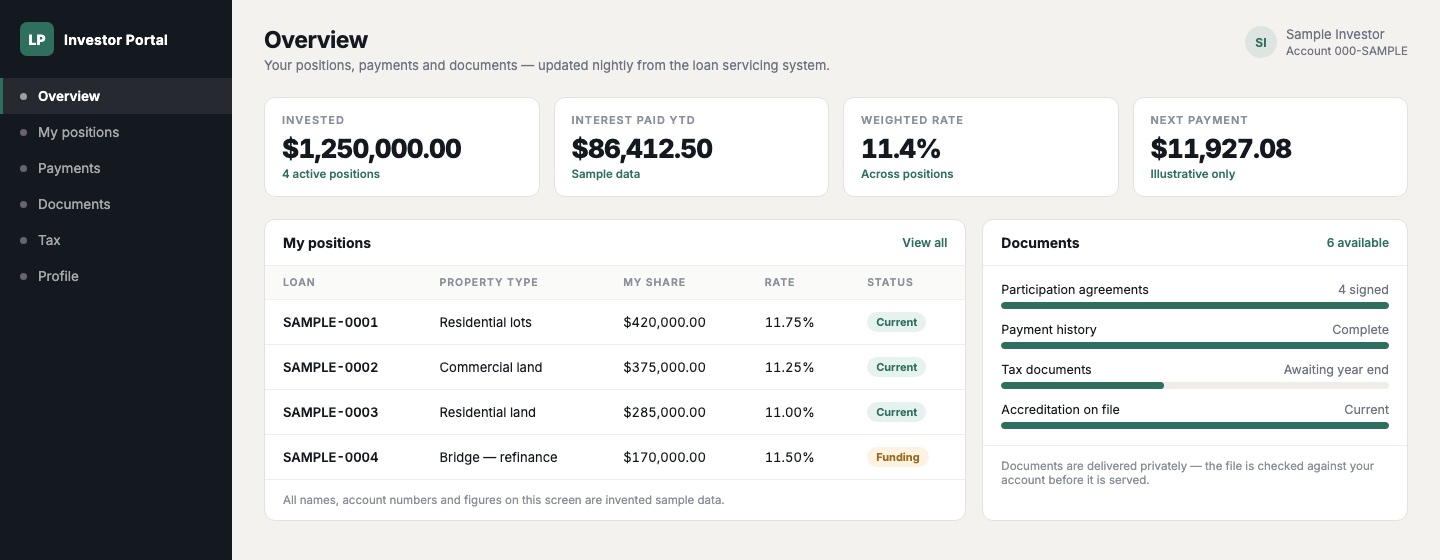
They were winning page one off a single page. The ceiling wasn't their ranking — it was that they only had one thing to rank.
Where it stands
Live. The site cut over on a Friday night with the old one kept reachable as a fallback, and the portal has been in daily use since the spring.
We took a full search baseline four days before launch — authority, keywords, traffic and what that traffic is worth — precisely so the before-and-after would be a measurement rather than a claim. Search takes weeks to re-crawl a site that went from one working page to seventeen, so the honest position today is: the baseline is on record, and the next reading is the one that counts.
The first thing the client's own team did after launch was compare the portal against their servicing system line by line and send back two corrections. Both shipped the same day. That is the kind of client relationship the work is for.